
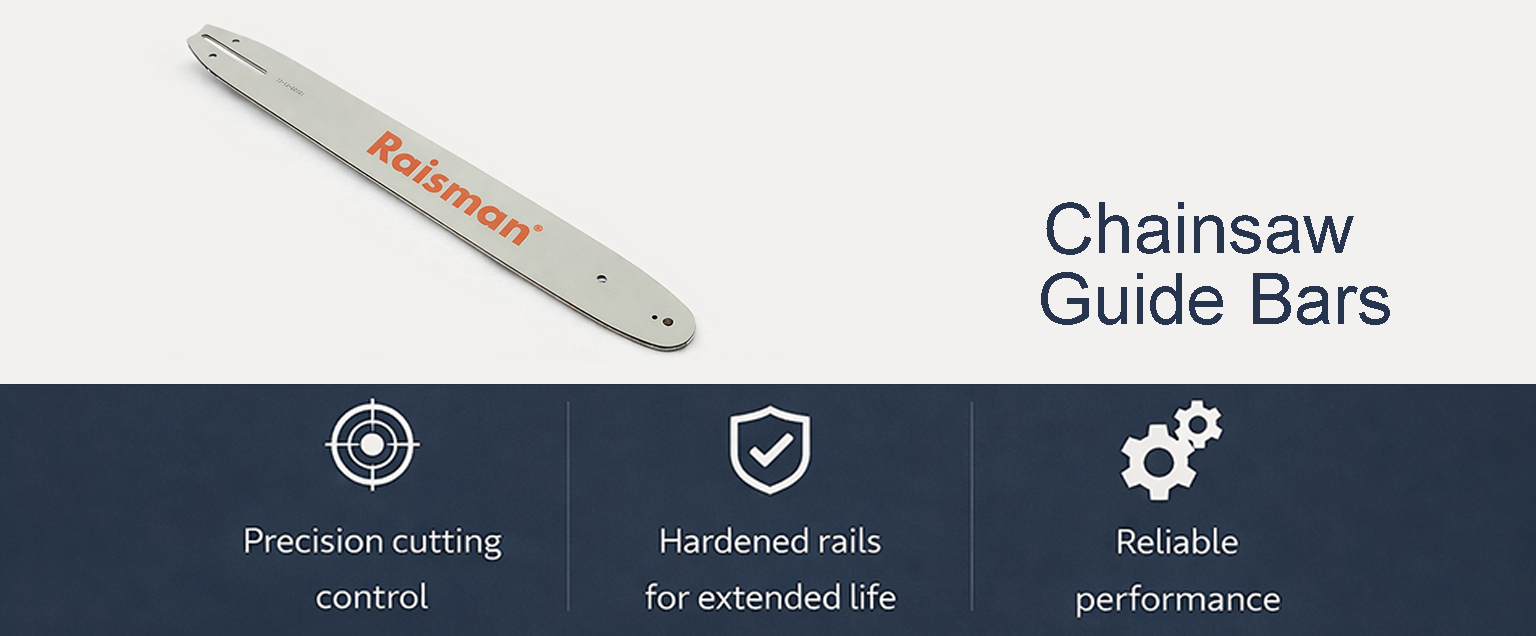
Raisman Guide Bar
Precision, durability, and compatibility for every type of user.
The Raisman guide bar line for chainsaws is designed to serve both professional and residential users, offering two main types engineered for different operating needs and usage profiles:
• Solid guide bars with hard nose
• Laminated guide bars with sprocket nose
Each type is manufactured to meet specific performance, durability, and maintenance requirements.
Solid guide bars with hard nose
Solid guide bars are manufactured from a single piece of steel, with the tip reinforced using a hard material known as Stellite, which provides exceptional resistance to wear.
This design is ideal for professional applications, as it eliminates moving parts at the nose, reducing maintenance requirements and increasing overall reliability. While these bars do not necessarily require more powerful engines due to weight, they do demand higher torque because of increased rotational resistance — especially during prolonged cuts or high-friction operations.
Laminated guide bars with sprocket nose
Laminated guide bars are constructed from three steel plates riveted together, offering a balanced combination of weight reduction, structural rigidity, and manufacturing efficiency.
They incorporate a sprocket at the tip, which reduces friction during cutting and improves chain movement. However, this design requires periodic maintenance, including cleaning and lubrication of the sprocket. Laminated bars are the most common choice for residential equipment and are also widely used in semi-professional applications.
Chain compatibility considerations
Chain compatibility depends on the guide bar design:
- For sprocket-nose guide bars, the chain pitch must match the pitch of the sprocket and the guide bar.
- For hard-nose guide bars, only the chain gauge needs to be respected, as there are no moving components at the tip.
Quality control and design integrity
Raisman adheres strictly to original equipment designs in terms of dimensions, mounting patterns, groove specifications, and overall geometry.
Each production batch is inspected for material hardness, dimensional accuracy, and Stellite weld integrity, ensuring long service life, cutting precision, and operational safety.